
The Most Common Questions We Get About Video Surveillance — Answered by Technicians Who’ve Been Doing This for 30 Years
- Chris Dudley

- Apr 3
- 9 min read
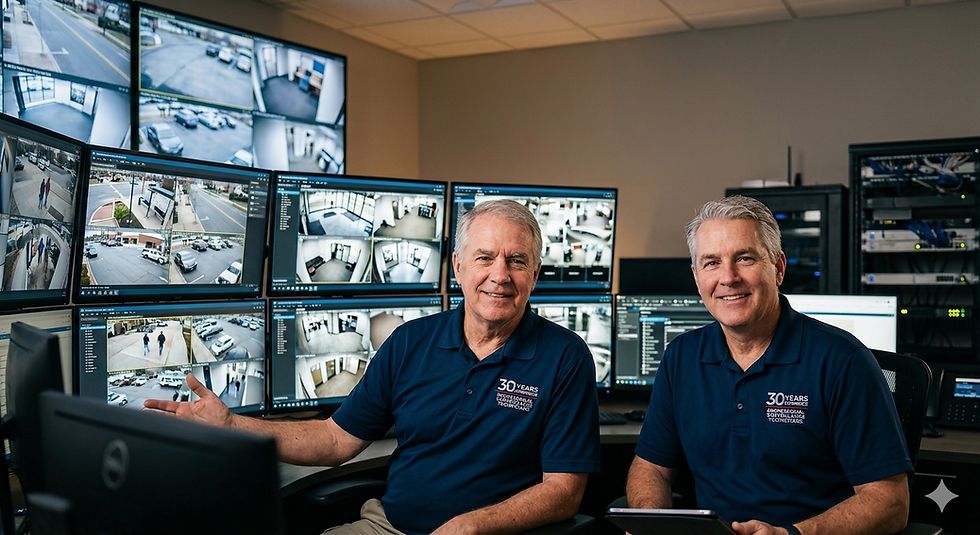
If you’re thinking about installing security cameras, you probably have the same questions most of our customers ask us when we walk a property for the first time.
How long do cameras record? Can I watch them from my phone? Will they work at night?Do I need cloud storage? How much footage can I actually keep? Can cameras be hacked?And maybe the biggest question of all: what really works in the field, and what just sounds good in a sales pitch?
At Ameritechs, we’ve been installing low-voltage systems since 1996, and after nearly 30 years in the field, we can tell you this: the best surveillance system is not the one with the longest spec sheet. It’s the one that actually fits the property, records when it matters, and gives you footage you can use when something happens.
Here are the real answers we give customers every week.
1. How long do security cameras keep footage?
This is probably the question we get more than any other, and the real answer is: most CCTV systems can keep footage a lot longer than people think because the video is compressed.
In the real world, a camera scene usually does not change very much from one second to the next. A parking lot at 2:00 AM may look almost identical for hours, with only small changes like a person walking by, a car pulling in, or lights shifting slightly. Because of that, most modern surveillance systems do not store every frame as if it were a completely new image. They compress the footage by keeping the important changes and reducing the amount of data used for the parts of the image that stay mostly the same.
That is one of the main reasons a recorder can hold days or weeks of video instead of filling up immediately.
On Uniview systems, one of the technologies that helps with this is U-Code. In simple terms, U-Code helps the recorder use storage more efficiently by reducing the amount of data used in the parts of the image that stay mostly still, while preserving detail where changes are happening. What that means for the customer is simple: if most of the scene is not moving, the system does not waste storage treating every second like a brand-new picture.
From our experience in the field, though, storage time still depends on a few big factors:
how many cameras you have
what resolution they are recording at
whether they record continuously or only on motion
how busy the scene is
how much hard drive space the recorder has
A quiet warehouse aisle will usually store much longer than a busy front entrance because there is simply less changing in the image.
So when a customer asks, “Will this keep 30 days of footage?” the right answer is not to guess. The right answer is to size the recorder and settings around the retention goal. That is how we approach it in the field. We do not just install cameras — we look at the scene, the activity level, the recording mode, and the compression tools available, then build the system around how long the customer actually wants to keep footage.
2. Is cloud storage better than local recording?
Not always.
This is where marketing and real-world performance can be very different.
Cloud storage sounds great because it feels simple. In some cases, it is. But in the field, we’ve found that cloud-only systems are not always the best fit, especially for larger properties or customers who want multiple high-resolution cameras.
Why? Because cloud recording depends heavily on internet upload speed, subscription costs, and bandwidth. If your internet connection is weak or unstable, your camera system can suffer.
That’s why many of the systems we install use local recording to an NVR or recorder, sometimes combined with remote access on a phone. This gives customers a strong balance of reliability and convenience. The cameras record on-site, but you can still pull up live or recorded video from almost anywhere.
For many homes and businesses, local recording with remote viewing is the sweet spot.
3. Can I view my cameras from my phone?
Yes — and most customers expect that now.
In fact, if a system does not make mobile viewing easy, people get frustrated quickly.
The good news is that modern surveillance systems can usually give you:
live viewing
playback of recorded events
motion alerts
access for multiple users
remote system health monitoring
That said, not every remote app is equal. Some are fast and easy to use. Some are clunky. Some work well until the installer leaves and no one remembers the passwords.
From our experience, one of the most important parts of an installation is not just mounting the cameras. It’s making sure the customer can actually use the system after we leave. That means setting up remote access properly, labeling cameras clearly, testing playback, and showing the customer how to use the app.
A surveillance system is only useful if you can get to the footage when you need it.
4. Do security cameras really deter crime?
Yes — but only if they are visible, placed correctly, and working.
We’ve seen plenty of properties where the cameras were technically installed, but they were pointed in the wrong place, mounted too high, or positioned so far away that they couldn’t capture useful detail.
A camera can absolutely deter theft, vandalism, trespassing, and nuisance behavior. But it has to be part of a real plan.
Good camera placement matters more than people realize. You want to cover:
entrances and exits
driveways and gates
common traffic paths
blind spots
areas where incidents are most likely to happen
We always tell customers: coverage is not the same as identification.
You may be able to see that someone was on the property, but not identify who they were unless the camera angle, height, lighting, and resolution are right. That’s why field experience matters. A good technician knows where to place a camera so it gives you usable evidence, not just video.
5. Will cameras work at night?
They can work very well at night — if you use the right camera for the environment.
Night performance is one of the biggest places where cheap camera systems disappoint people. A camera may look fine during the day, but once the sun goes down, that is when you find out what the system can really do.
From our experience in the field, good night surveillance depends on a few key things:
camera quality
sensor size
lens aperture
available light
mounting height and angle
how the camera processes low-light scenes
This is where newer technology has made a big difference. For example, Uniview’s Owl View series is designed for extremely low-light environments. In plain English, these cameras use AI-enhanced image processing and low-light technology to brighten and clean up very dark scenes. Instead of giving you the typical dark, muddy nighttime image that many older cameras produce, they can pull out much more usable color, detail, and clarity.
On the right property, that can make footage from an area that looks almost pitch black to the human eye appear much closer to near daytime clarity than people expect from a nighttime camera.
That said, even the best low-light camera still depends on the environment and the installation. We have seen in the field that the biggest mistakes at night usually come from poor placement, not just poor equipment. If a camera is pointed into headlights, reflective walls, glass, or other glare sources, even a good camera can struggle. If it is mounted too high, you may see the top of a person’s head instead of their face.
So the real answer is: yes, cameras can work very well at night — but only when the camera is matched to the job. A good low-light camera like Uniview’s Owl View series can make a huge difference, especially in areas that are close to pitch black, but the best results still come from proper design, placement, and setup.
6. Can security cameras be hacked?
The honest answer is yes — any device connected to a network can be vulnerable if it is installed or maintained poorly. But there is a big difference between a professionally designed system and one that was thrown together with weak passwords, default settings, and bargain hardware.
One thing we talk to customers about is NDAA compliance.
In simple terms, NDAA-compliant equipment means the cameras and related hardware are not using certain manufacturers that have been restricted in federal applications. For many customers, especially government, commercial, and security-conscious buyers, that matters. It is one more way to avoid questionable equipment sources and choose products that are viewed as more acceptable for secure environments.
But this is the important part: NDAA compliance does not mean a system is automatically hack-proof. It is about sourcing and compliance, not a guarantee that no one can ever compromise the system.
A good camera system still has to be installed securely. That means:
changing default usernames and passwords
using strong unique credentials
keeping firmware up to date
securing the network the cameras sit on
limiting unnecessary internet exposure
using reputable manufacturers and properly configured recorders
From our experience in the field, the biggest risks usually are not some movie-style hacker targeting a camera out of nowhere. The bigger risks are lazy setup, old firmware, open ports, weak passwords, and cheap equipment with poor long-term support.
That is why we recommend using professional-grade, NDAA-compliant options when appropriate, and then making sure the system is configured correctly from day one. A surveillance system should not just be installed — it should be hardened.
7. How many cameras do I actually need?
Usually fewer than people think in some places, and more than they think in others.
A lot of customers start by saying, “I just want to cover the property.” But once we walk the site, we usually find that some areas matter a lot more than others.
The goal is not to put cameras everywhere. The goal is to put cameras where they will solve real problems.
A smaller, well-designed system often performs better than a larger system with bad angles and weak coverage.
When we assess a property, we look at:
what you are trying to protect
where people enter and exit
high-risk zones
lighting conditions
cabling routes
network availability
future expansion
That last part matters too. We like to install systems that make sense now, but can grow later if needed.
8. Should cameras record 24/7 or only on motion?
There is no one-size-fits-all answer.
For some properties, 24/7 recording makes the most sense. For others, motion recording is more efficient and saves a lot of storage.
In the field, we often recommend this approach:
use continuous recording where full history matters
use motion-based recording where traffic is lighter or storage needs to be extended
adjust sensitivity carefully so the system records real events, not every shadow or branch moving in the wind
Bad motion settings are a common frustration. Too sensitive, and the customer gets constant false alerts. Not sensitive enough, and the event gets missed.
This is where setup and testing matter. A properly configured system should reduce noise and capture what matters.
9. What’s the difference between a cheap camera system and a professional one?
The difference is usually not just the camera. It’s the entire system design.
Cheap systems often look attractive because of the upfront price. But what customers end up paying for later is poor reliability, weak images, short equipment life, bad apps, and missing footage when they need it most.
A professional-grade system usually gives you:
better image quality where it counts
more reliable recording
better remote access
stronger hardware
more flexible storage options
better long-term serviceability
And maybe most importantly, you get a system installed by someone who understands real-world conditions, not just product packaging.
10. What should I look for when hiring a surveillance installer?
Look for experience, yes — but also look for judgment.
A good installer should be able to explain:
why each camera is going where it’s going
what kind of image you should expect
how long footage will be retained
how you will access the system
what happens if the internet goes down
how the system can be serviced later
They should also be realistic. Be cautious of anyone who promises perfect coverage, perfect facial detail at long distances, or a huge system for a suspiciously low price.
The right installer will help you understand tradeoffs and make smart decisions.
What We’ve Learned After 30 Years in the Field
After nearly three decades in low-voltage and surveillance work, here’s the biggest thing we can tell you:
A camera system is only as good as its design, installation, and setup.
You can buy good equipment and still end up with bad results if the cameras are in the wrong place, the recorder is undersized, the app isn’t configured, or the customer was never shown how to use it.
On the other hand, when a system is designed around the real property and the real needs of the customer, it becomes incredibly valuable. It helps protect people, reduce liability, resolve disputes, deter crime, and give peace of mind.
That’s what we aim for on every project.
Need Help Designing the Right Surveillance System?
At Ameritechs, we’ve been installing and servicing surveillance systems since 1996. We help homeowners, businesses, mobile home communities, and commercial properties design systems that are practical, reliable, and built for the real world.
If you’re thinking about upgrading an old system or installing cameras for the first time, we’d be glad to help you figure out what actually makes sense for your property.

Comments